
Brodo di pollo is the backbone of Italian home cooking — a clear, golden chicken broth made slowly with bone-in chicken, vegetables, and patience. In Italy, brodo isn’t just soup: it’s nourishment, tradition, and the starting point for countless dishes, from pastina in brodo to risotto, tortellini, and delicate sauces.
This is the authentic Italian way to make chicken broth: no shortcuts, no bouillon cubes, no aggressive boiling. Just time, care, and simple ingredients.
WHAT IS BRODO DI POLLO?
Brodo di pollo is a clear Italian chicken broth, gently simmered to extract flavor without cloudiness. Unlike American “chicken stock,” which is often reduced, concentrated, or heavily seasoned, Italian brodo is light, clean, and balanced — designed to be sipped on its own or used as a refined base.
In Italian kitchens, brodo is considered curative food. It’s what you eat when you’re sick, tired, grieving, or simply in need of comfort.
BROTH IN DIFFERENT FOOD CULTURES
Nearly every cuisine has its own version of chicken broth, but intent and technique vary.
- France – Bouillon de volaille (herb-forward, often clarified).
- China – Clear chicken stock with ginger and scallion.
- Japan – Chicken-based broths ranging from light to creamy.
- Mexico – Caldo de pollo with vegetables and herbs.
- Jewish cuisine – Long-simmered chicken soup focused on nourishment.
WHY THIS RECIPE WORKS
This recipe follows traditional Italian technique:
- Whole or bone-in chicken for natural gelatin and depth.
- Cold-water start for clarity.
- Gentle simmer (never a rolling boil).
- Minimal seasoning, added at the end.
It’s the same method used by generations of Italian home cooks — including the way I learned growing up.
INGREDIENTS FOR AUTHENTIC BRODO DI POLLO
- Whole chicken (or bone-in chicken parts) : I used bon in in chicken part with skin on. You can always clear the broth for the fat, but the skin will ggive it more taste, the bone-in are rich in collagen that will slowly be released through simmering and enrich your broth.
- Carrots, Celery and Yellow Onion: a medium size of eack, cleaned and cut in parts: will add flavor and minerals to the broth.
- Parsley stems : will add some freshness.
- Black peppercorns: will give some gentle heat.
- Bay Leaf: they pair well chicken and will add some earthy notes.
- Coarse sea salt (added at the end)
- Cold water
👉 No garlic, no herbs. Italian brodo is intentionally restrained.

AROMATIC VARIATIONS FOR BRODO DI POLLO (BEYOND THE CLASSIC SOFFRITTO)
Once you master the base, you can gently adapt brodo using seasonal or regional aromatics.
- Delicate & Elegant
- Fennel bulb (½, chopped): Adds subtle sweetness and a soft anise note — excellent with chicken-only brodo.
- Warm & Comforting
- Onion studded with clove (1 clove only): A traditional northern Italian touch, especially in winter brodo.
- Herbal Variations (Use Sparingly)
- Thyme – clean and modern
- Rosemary – rustic and aromatic
- Sage – best if broth will be paired with poultry dishes
- Avoid garlic: it overwhelms the broth rather than supporting it.
HOW TO MAKE BRODO DI POLLO MORE ACIDIC
Italian brodo is meant to be gentle, but acidity can be added with restraint to brighten flavor.
- White wine: Add a small splash during the first 10 minutes, then let it cook off.
- Lemon juice or mild vinegar: Add only after cooking — a few drops at a time.
- Tomato peel or a small tomato: A southern Italian variation that adds both sweetness and acidity.
TIP: Acidity should lift the broth, never announce itself.
CAN I MAKE BRODO USING ONLY CHICKEN?
Yes — and it’s extremely common in Italian households. Traditionally, the chicken is cooked first for brodo — then reused for second courses, salads, or fillings.
- Chicken-Only Brodo
- Made with a whole chicken or parts (backs, wings, necks)
- Lighter, cleaner, more delicate
- Ideal for sipping, pastina, tortellini, or risotto
- Chicken + Extra Bones
- Adds more body and gelatin
- Deeper mouthfeel without heaviness
- Beef + Bones:
- Made with meat (beef, veal, turkey, duck) and bones
- Deeper flavor, ideal for cooking meat stew that requires long cooking (Brasato)
- Seafood:
- Head, bones, parts
- Ideal for seafood based dishes: stew or risotto.
The procedure is the same, depends on the use you will make.
HOW TO MAKE BRODO DI POLLO (STEP-BY-STEP)
1. Start with Cold Water
Place the chicken and vegetables in a large pot and cover completely with cold water. This allows flavors to extract gradually.
2. Bring to a Gentle Simmer
Heat uncovered until tiny bubbles appear. Skim foam gently if needed. Never boil — boiling clouds the broth and toughens the meat.


3. Simmer Slowly
Let simmer uncovered for 2½ to 3 hours, maintaining barely-there movement.
4. Season at the End
Add salt only once the broth is done. This keeps flavor balanced and flexible.
5. Strain
Remove solids and strain for a clean, golden broth.


6. Refrigerate overnight
Tip: chill overnight and remove solidified fat if you want a lighter broth.This will aid additional fat to deposit on top.
7. Strain
Strain again through a colander.


8. Refrigerate or freeze it.
Depends on the use, you can now keep it in the fridge or store in freezable containers.


BRODO DI POLLO TIPS & GUIDELINES (ITALIAN TECHNIQUE)
These small details separate a flat broth from a deeply nourishing one.
- Start with cold water: Cold water extracts collagen and flavor slowly and evenly.
- Bring to a gentle simmer, never a boil: Boiling clouds the broth and dulls flavor.
- Skim early, then stop: Remove foam only in the beginning — don’t overwork it.
- Avoid stirring: Let ingredients infuse naturally.
- Salt lightly or not at all: Season later depending on how the broth will be used.
- Simmer uncovered or partially covered: Allows natural concentration without aggressive reduction.

Ingredients
- 1.25 pound chicken thighs and drumsticks bone in, skin on
- 1 medium carrot peeled, cut in 4 parts
- 1 stalk celery cut in 4 parts
- 1 medium onion peeled, cut in quarter
- 1 bunch parsley small
- 2 unit bay leaves
- 10 unit black peppercorns whole
- 1 tsp coarse salt
- 4 cups water
Instructions
- Place chicken, vegetables, parsley, bay leaves and peppercorns in a large pot.
- Cover completely with cold water.
- Bring slowly to a gentle simmer over medium heat.Do not boil.
- Skim any foam that rises during the first 20 minutes.
- Lower heat and simmer uncovered for 2½–3hours, maintaining barely visible movement.
- Remove chicken and vegetables. Strain broth through a fine mesh sieve.
- Season with salt only after straining.
ONLY IF YOU WANT A CLEAR BROTH
- Refrigerate overnight.
- Strain broth through a fine mesh sieve.
- Now store in refrigerator if using within 3 days, or freeze it.
Notes
- Never boil the broth — it will turn cloudy.
- Salt at the end so the broth stays versatile for different dishes.
- Chill overnight and remove solidified fat if desired.
Nutrition
FAQ – BRODO DI POLLO
Can I use chicken breasts only?
You can, but you shouldn’t. Bones and skin create flavor and body.
Why is my broth cloudy?
Likely boiled too hard or stirred. Keep the simmer gentle.
Can I add herbs or garlic?
Traditional Italian brodo does not. Add herbs later, in the final dish.
Is brodo di pollo the same as chicken soup?
No. Brodo is the broth itself; soup comes later.
Can I make it in a pressure cooker?
Yes, but the flavor is less nuanced. Traditional simmering is preferred.
Can I eat the vegetables?
Yes, you can use them in soups, stew they will add more flavor.
What can I do with the boiled chicken?
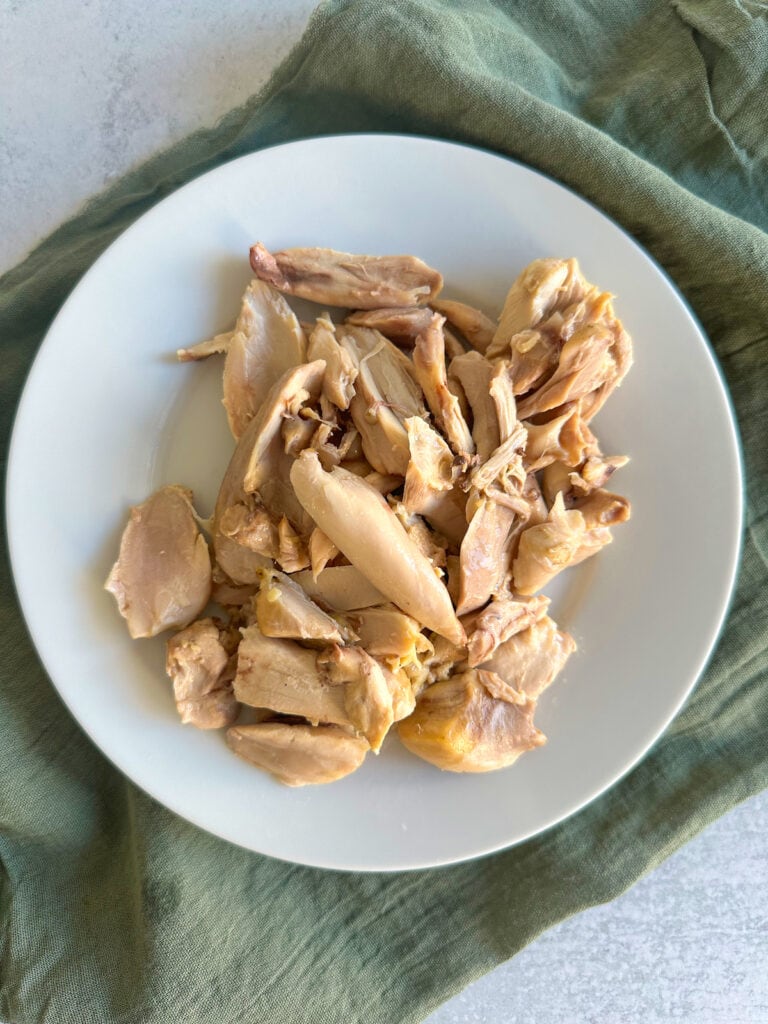
Use boiled chicken for chicken soup, salads, sandwiches. Shred it with your hands, to have small long pieces that will absorb any sauce, soup much better.


HOW ITALIANS USE BRODO DI POLLO
Brodo di pollo is rarely just “chicken soup.” It’s used for:
- Pastina in brodo (childhood staple).
- Tortellini in brodo: classic dish from Emilia Romagna.
- Risotto (especially delicate vegetable or saffron risotto): will be a good one to add to an artichoke risotto.
- Brodo sgrassato for sauces or for richer soup with beans, grains or to enrich stew such as Classic Chicken Cacciatora, or Chicken meatballs with mushrooms.
- Sipping broth when sick or fasting.
WHAT MAKES ITALIAN BRODO DIFFERENT FROM STOCK?
| Italian Brodo | American Stock |
| Clear, light | Often dense and reduced |
| Whole chicken, or thighs and drumstick | Mostly bones |
| Minimal seasoning | Heavily seasoned |
| Served on its own | Mainly a cooking base |
STORAGE & FREEZING
- Refrigerator: up to 4 days
- Freezer: up to 3 months . Freeze in small containers for risotto or soup portions.
Tip: refrigerate in ice cube tray, if you want to add it to stews, sauces to add flavors.
MORE WARMING RECIPES FOR YOU
Guide to winter pasta sauces: a needed 1010 guide for best sauce for cozy, comforting winter pasta recipes.
Lentil soup with Prosciutto Crudo: a nourishing meal, rich in protein and fiber.


Pinza: a classic Epiphany cake, good to eat in colder months with a glass of milk.
Crostoli: classic Carnival dish from the Venetian inland.


✨ This Brodo di Pollo Recipe is a classic winter staple! I would love to connect with you through my recipe and I will be very appreciative of your comments! If you make this recipe make sure to tag me on Instagram @Italian_Kitchen_Confessions.To get more ideas follow me on Pinterest.✨


