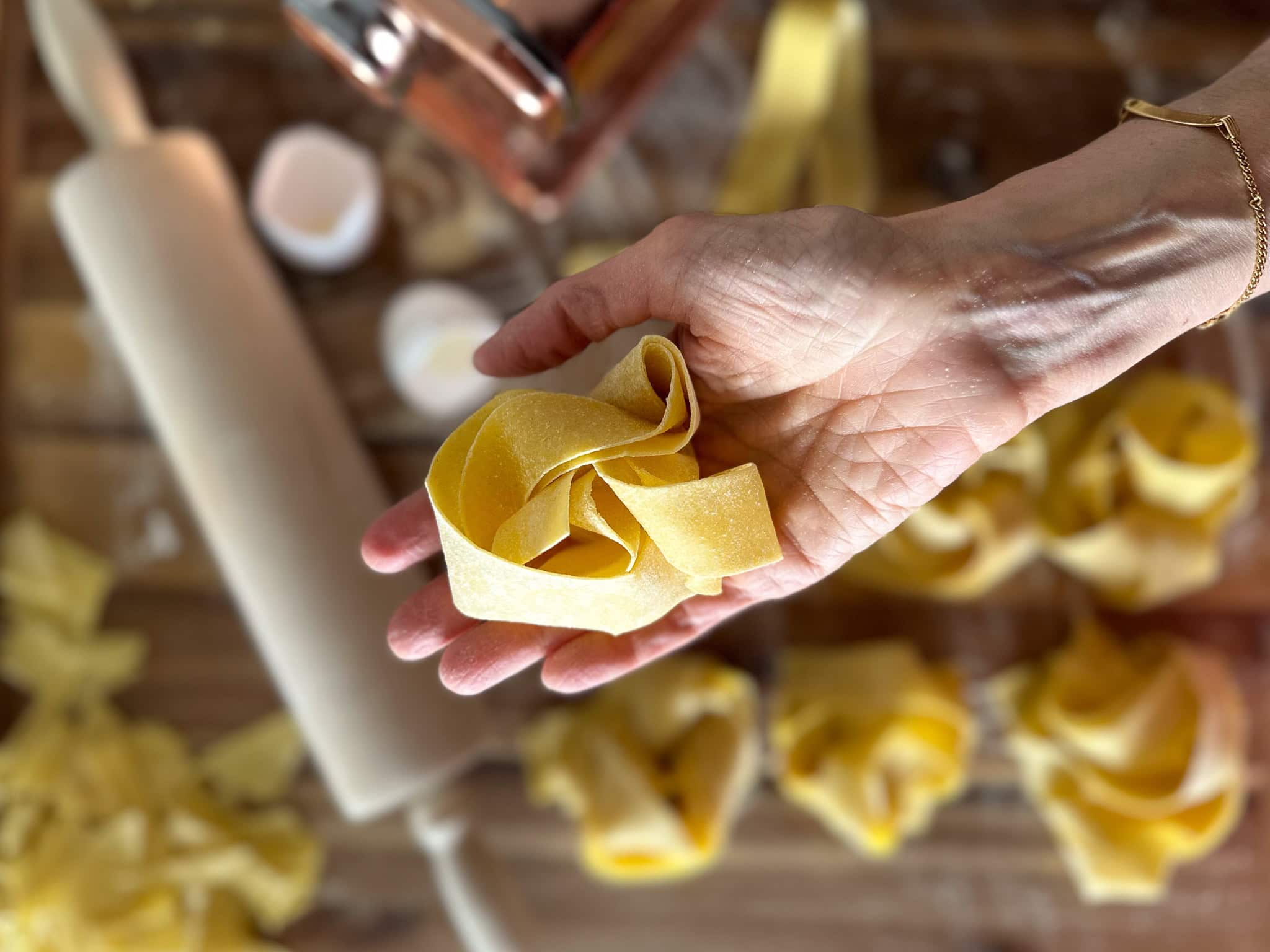
Let’s learn how to make homemade pappardelle pasta from scratch! This is the perfect way to spend the time in a cold winter day, especially if you plan to pair it with ragu’, as I usually do. Your house will smell divine and all the family will gather around the kitchen!
WHAT ARE PAPPARDELLE?
Pappardelle is a long, wide pasta ribbon that is made with egg pastadough. Originated in Tuscany, Pappardelle (“pah-ppahr-dell-eh”) derived from the Italian verb “pappare” which means to eat hungrily. And definitely you will as this pasta is delicious when combined with a hearty and meaty ragu or a mushroom sauce. Which pairs well with the unique and flat shape of this pasta recipe.
It’s usually about 1 inch (2.5 cm) wide. Its thickness is 1/16 inch (1-2 mm). It can be hand-cut with a knife or fluted pastry wheel for a decorative touch. ( to not confuse with mafaldine, which are also long ribbon noodles, but are less wide)
If you want to discover more about all the different kinds of fresh homemade pasta recipes, read my post.
WHY THIS RECIPE IS SPECIAL
– This is one the classic homemade pasta recipe that is not over complicated and requires only a few tools, you could just do it with a rolling pin, a knife and lot of strength in your arms to roll thin the pasta dough!
– Pappardelle pasta is a fall-winter recipe, ideal for meat sauces, or mushrooms sauces, but it is very versatile all year around.
– It is a staple of Italian cooking, along with fettuccine and tagliatelle.

PAPPARDELLE PASTA RECIPE: NOTES ON INGREDIENTS
Making Pappardelle pasta is less daunting than it seems and once you will take the habit, you will love making homemade pasta! I must confess that it is exciting to see how few basic ingredients, when combined, give life to such a mouthwatering meal.
Let’s discuss the importance of quality ingredients in the process of pasta making:
Flour: To make homemade pappardelle I used Caputo 00 Flour and semolina or durum wheat flour as the final result is more rustic and it better holds a rich sauce like ragu’. In general, when you serve homemade pasta with a rich sauce, using semolina flour in the dough will give a full sensation of roundness in your palate.
Eggs: this recipe calls for 4 eggs, possibly at room temperature. You will use both the yolk and the whites.
EVOO: it adds moisture to the dough and eases the kneading. You can also add a few tablespoons of water at room temperature.
Salt: please remember to add salt to the dough and of course always add salt to the cooking water.
TOOLS TO USE
A rolling pin is always good to have especially to flatten the dough before using the pasta machine. Specifically for this pappardelle shape, you can use just a rolling pin and of course your muscles! 🙂
Wooden board – Key for any pasta making, you can use your own counter top or a large size wooden board as a good start. If you fall in love with pasta making I recommend to upgrade to a bigger one, like this. A wooden board will prevent your counter top from getting ruined by cutting the dough and then the flattened noodle, and it will also be easier to clean up.
A sharp knife: it will be necessary to cut the pappardelle. If you really get into the habits of making your homemade pasta, I also recommend a pasta cutter A pizza wheel will also do the trick.
Plastic wrap: you will use it to wrap your dough for the resting phase. Also, remember that your dough needs to stay cover when you are cutting the dough. If the dough gets dry at contact with air, it will be harder to flatten it and work it into pappardelle noodles. A tea towel will work too.
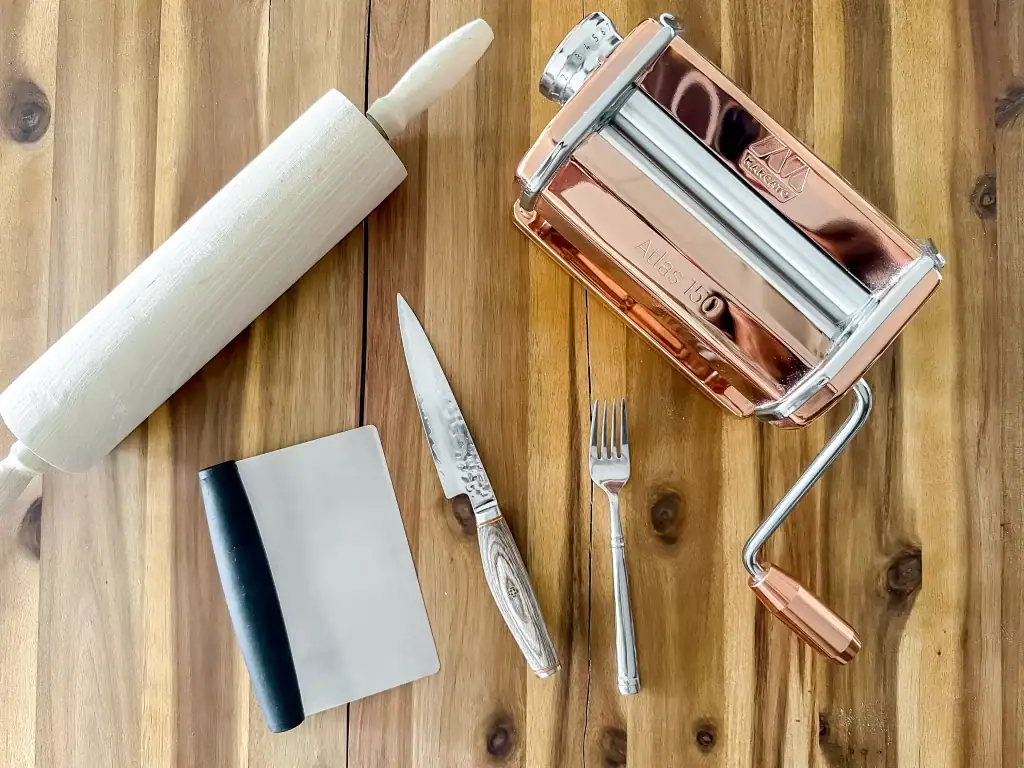
Pasta machine – I use a marcato Atlas pasta machine. You can also find a more affordable model here. I recommend though Marcato as with the time you can buy different attachments to vary your pasta shaping.
You will need also a bench scraper will help you to bring the dough together once you have cracked the eggs.
Finally I suggest investing in good quality digital food scale: it will provide you with the precise measure for the ingredients, ensuring the correct ratio of flour to eggs.
HOW TO MAKE PAPPARDELLE PASTA
This recipe will make 1 pound of fresh pasta, which is enough for 4 servings as a main course.
Make the homemade pasta dough
Form a wheel with the flour, previously sifted. Add the salt, the EVOO, and break the eggs into the wheel, whisking them with a fork. Incorporate the flour as you whisk. You might need to add a bit of chilled water to make the dough more loosely, but add a bit at a time, otherwise, you will have a mushy dough that will not be easy to adjust to maintain the ratio of flour to eggs.
Alternatively you can use the dough in a stand mixer, even if doing it by end will allow you to feel the dough. Feeling the dough is important to understand the right level of elasticity that will result in a much better quality of fresh pappardelle.


Knead the dough on a floured work surface, until you have a final dough that is smooth and elastic. Cover the dough in a plastic wrap, place it in the refrigerator for 30 minute.


Rest the dough
This is a very important step: Resting the dough will allow the pasta to fully absorb the eggs, giving the dough the right consisentcy for you to be able to shape it. Make sure you do not skip this step!
Cover the dough in a plastic wrap, place it in the refrigerator for 30 minutes. Alternatively you can cover it with a tea towel or an upside down bowl and live it at room temperature, away from any source of heat or cold air.
Roll out the dough
After you rested the dough for 30 minutes, divide it into 4 parts and cover them with a linen towel to prevent your dough to dry. With a rolling pin well-floured, start by rolling each piece from the center to the outer part on a floured countertop. When it reaches around 1/8 inch of thickness, the you are ready to use a pasta machine.
At this point I use a pasta machine and pass the dough through its rollers. I use the thickness of 0 at first, then I pass it to more times into thinner thickness. I usually proceed from 0 to 2, then 3, then 4 and then 6. By doing this, you will obtain the lasagna, which is a wide stripe of pasta. You will know it is the right thickness when you will see clearly the shadow of your hands if you will elevate your sheet against the window. ( Windows test!).


Cutting the rolled pasta dough into Pappardelle
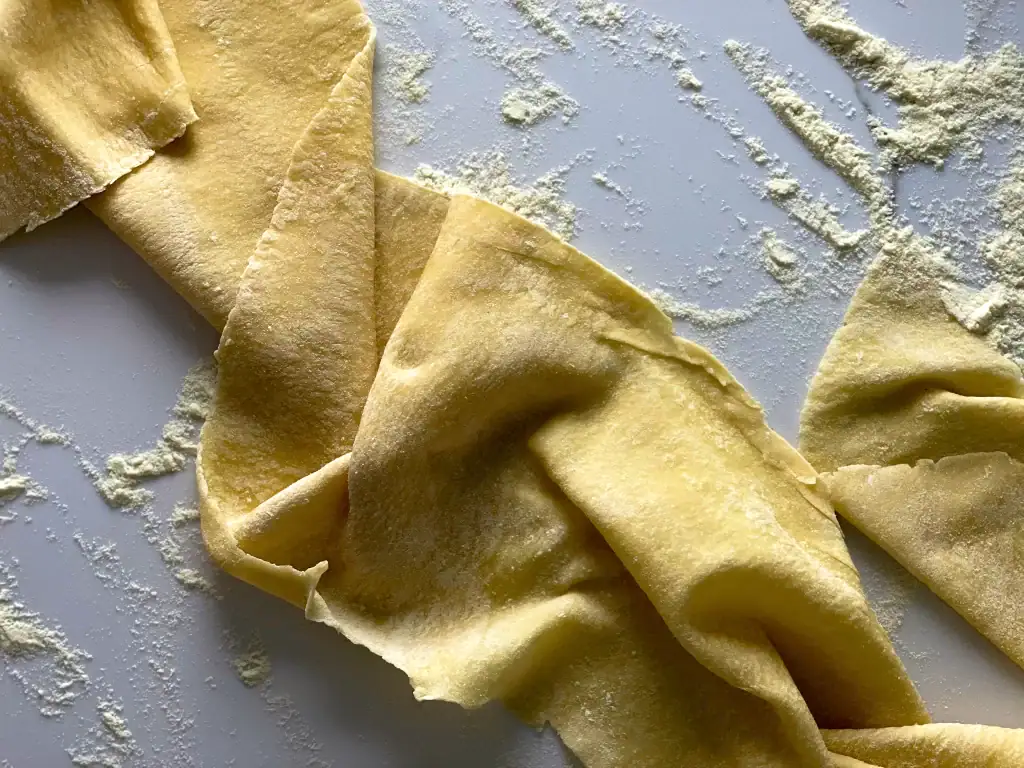
Pappardelle is cut by hands. Ensure your counter is well floured as well as the pasta sheet. This will avoid the pasta to stick. Lay your pasta sheet and fold it in half.

Then fold it over in half another time and then one more last time. Proceed to cut it into 1 inch thick pieces. You have obtained pappardelle.


Once you have cut the sheet, you will need to separate each one of the pappardelle individually and place them on a floured wooden-board. I insist on the importance of a well-floured counter-top, rolling pin and wooden board to avoid the pasta to stick to any of these surfaces.

COOKING PAPPARDELLE
Bring to boil a pot of water. When the water boils, add rock salt. Then add the pappardelle and cook it for 8 minutes. Using a pasta fork, drain the pasta and add it the pot where you have your pappardelle sauce. Add a splash of pasta cooking water, and toss for a few minutes. Plate it and toss it with a bit of parsley, black pepper and Parmigiano Reggiano. Enjoy it!


Equipment
- Roll-pin
Ingredients
- 1 cups flour 00 flour
- 2 tbsp flour 00 flour
- 2 tbsp flour durum wheat flour
- 4 eggs
- 3 tbsp water (see notes)
- 1 pinch salt
- 1 tbsp olive oil extra virgin
- 2 tbsp rock salt
Instructions
STEP 1: MAKE THE HOMEMADE PASTA DOUGH
- Form a wheel with the flour, previously sifted. Add the salt, the EVOO, and break the eggs into the wheel, whisking them with a fork. Incorporate the flour as you whisk. You might need to add a bit of chilled water to make the dough more loosely, but add a bit at a time, otherwise, you will have a mushy dough that will not be easy to adjust to maintain the ratio of flour to eggs.
- Alternatively you can use the dough in a stand mixer, even if doing it by end will allow you to feel the dough. Feeling the dough is important to understand the right level of elasticity that will result in a much better quality of fresh pappardelle.
- Knead the dough on a floured work surface, until you have a final dough that is smooth and elastic. Cover the dough in a plastic wrap, place it in the refrigerator for 30 minutes.
STEP 2: ROLL OUT THE DOUGH
- Remove the dough from the refrigerator, divide it into 4 parts and cover them with a linen towel to prevent your dough to dry.
- With a rolling pin well-floured, start by rolling each piece from the center to the outer part on a floured countertop. When it reaches around 1/8 inch of thickness, you are then ready to roll the cut the pasta sheet you just obtained into pappardelle.
STEP 3: CUTTING THE ROLLED PASTA DOUGH INTO PAPPARDELLE
- At this point I use a pasta machine and pass the dough through its rollers. I use the thickness of 0 at first, then I pass it to more times into thinner thickness. I usually proceed from 0 to 2, then 3, then 4 and then 6. By doing this, you will obtain the lasagna, which is a wide stripe of pasta. You will know it is the right thickness when you will see clearly the shadow of your hands if you will elevate your sheet against the window.
- Do not cover the long sheet, so that the moist surface will dry slightly before cutting it, resulting in a neat cut. Now you can cut the pappardelle. Fold the dough into half, by rolling the dough from the longest side. Then fold it in half again. At this point with a sharp knife cut the fettuccine 3/4 to 1 inch wide.
- Once you have cut the sheet, you will need to open the pappardelle and make some nice nest. Place them on a lightly floured surface, better if it is a wooden-board. I insist on the importance of a well-floured counter-top, rolling pin and wooden board to avoid the pasta to stick to any of these surfaces.
STEP 4: COOK THE PAPPARDELLE PASTA
- Bring to boil a pot of water. Add salt when the pasta is at roaring boil. Add the pasta and cook it for 5 minutes. Using a pasta drainer, drain the fresh homemade pappardelle pasta into the pot where you have your favorite sauce.
Notes
- You can use all-purpose flour. Durum-wheat flour gives a better tenure during the cooking.
- Add the water carefully, otherwise, you will have to review the ratio of flour to eggs.
- Use a wooden rolling pin, well-floured, it will prevent the dough to stick to it while you are rolling it out.
- This recipe yields 1 pound of pasta, ideal for 4 servings as a main course or for 6 serving as first serving.
Nutrition
FAQs
Can I roll out the pasta dough with a rolling pin?
Yes, you can especially if you do not have a pasta machine. It will be harder, but it is totally feasible. Italian nonnas still nowadays they roll out the dough by hand. Make sure your pin is dusted, to prevent sticking.
How wide should you cut pappardelle?
The standard width is 1inch, but you can do eeven 2 inch for very wide dramatic noodles.
How long should I cook pappardelle for?
In general fresh pasta takes only a few minutes. Check the pappardelle after 2 minutes. They should be done.
Which setting on my pasta machine I should out to roll out pappardelle?
You will start from 0 and then roll up to 6, to obtain pappardelle that are 1-2 mm thick. For more technical guidance, check my guide on how to make homemade pasta dough (egg-dough).
Can I make this recipe gluten-free?
Yes, you can. Just swap the 00 flour and the semola with gluten free flour in the same ratio.
Can I make pappardelle vegan?
Yes, simply omit the egg, and use water for half of the weight of the flour.
What is the difference between Pappardelle vs Tagliatelle?
Simply put, it’s the width. Tagliatelle is not as wide as pappardelle pasta, about 1/2 inch (1.25 cm). The egg dough and pasta thickness, about 1/16 inch (1-2 mm) is the same. Use the method below to cut both noodle shapes. And it is also the region of origin: Pappardelle are from Tuscany, while Tagliatelle are from Emilia Romagna.
What is the difference between Pappardelle vs Fettuccine?
Often associated with Roman cuisine, fettuccine is traditionally about 1/4 inch (6.5 mm) wide. So it is thinner, but it is also a but thicker, about ¼ of an inch, than Pappardelle.
HOW TO STORE PAPPARDELLE PASTA
Storing pasta requires some attention and care:
Short terms storage: if you are planning to eat the pappardelle within the same day, you can dust a baking sheet with semolina flour, lay the pappardelle on top and dust them with more semolina, to prevent sticking. Cover them with a tea towel, so theta they will not dry out. Just before cooking them, dust off the excess of flour.
Long term storage: If you make a big batch of pasta, you can freeze it for later consumption. I suggest to always dust a baking tray and lay over your pappardelle in nests, allow them to dry, for a few hours to make sure they are fully dry. Once they are dry, you can place them in plastic bag and freeze them. Cook them directly from frozen, do not thaw them.
WHICH SAUCE GOES WITH BEST PAPPARDELLE PASTA RECIPE
Wide Pappardelle ribbon goes well with a sauce that is enveloping the noodles in its richness, so that when you twirl it, you can taste in every bite the roundness of the noodle and the flavor of the sauce. Ideally a pasta that is not chunky, or that can contains a few small bits of meat, or vegetables.
Ragu: Probably the best sauce for this wide noodles. It will be a comforting, hearty meal ideal for a cozy night, or a Sunday family lunch in Italian style.
Homemade Pesto Sauce: A classic summer sauce, pesto Genovese will elegantly pair with pappardelle. Ideal for vegetarians!
Amatriciana Sauce:The velvelty spicy tomato sauce, contains chunks of guanciale (pork jawl), all dusted with pecorino cheese, for a quick sauce that never disappoints.
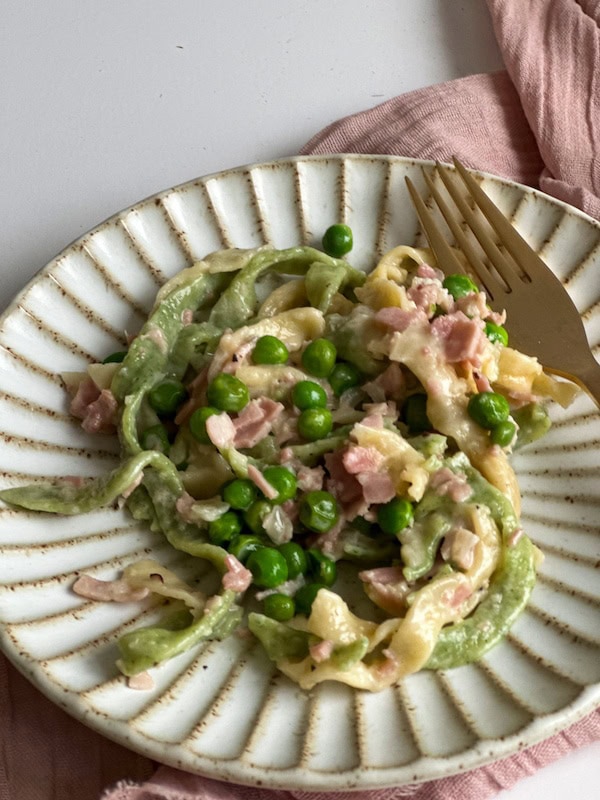
Creamy Peas and Ham Sauce:This is a great sauce to eat when peas are in season, think about spring or early summer.
Spicy Red Bell Pepper Sauce:Pesto Calabrese, is a spicy sauce that will coat your noodles in its savory richness.
HOW TO SERVE PAPPARDELLE PASTA
Pappardelle will be the main course, being such a great dish that is homemade, you want to ensure everyone at your table will enjoy the results of your work and passion.
When I make fresh homemade pasta, I tend to keep appetizer to a minimum, to ensure my guests have enough space to savor the main pasta event.
I recommend to start with an appetizer of Bruschetta, or an Italian Little Green Salad, both easy and quick to make, will be refreshing.
After the pappardelle, and maybe a second serving of the same, you can consider a few dessert options.
A Coffee Affogato, simple, easy maybe accompanied by some Homemade Cantucci (Almond Biscotti). A Classic Italian tiramisu, for a richer ending. Or a kefir panna cotta with strawberries for some tangy, sweet and light dessert.
WHICH WINE TO PAIR WITH PAPPARDELLE AL RAGU’
The choice of wine will depend on the sauce you will choose.
If you are planning to eat pappardelle with ragu or with a red base tomato sauce, I recommend a medium body wine.
- A Chianti Sangiovese or a Montepulciano d’Abruzzo are both valuable choices.
- Chianti is a popular choice. Its notes of tomato leaf match well with the ragu’ and overall it is a medium body wine, paired with a good level of acidity, balances well the beef ragu’ and the pasta.
- Montepulciano has notes of oregano and plum, it pairs great with rich food with a moderate to high amount of fat.
If you are going for a non meat based sauce (creamy, seafood or pesto), I recommend:
- a Pinot Grigio or a Vermentino, to bring up some acidity that matches with the richness of the pasta.
MORE HOMEMADE PASTA RECIPES FOR YOU
If you enjoyed making this pasta and planning to keep on doing it, I have for you several other long pasta shapes, entirely homemade!
Straw and Hay Fettuccine (Paglia e Fieno): this pasta recipe will teach how to make colored pasta!
Spelt Tagliatelle Pasta with Kale and Mushroom: a recipe using spelt (farro flour) to shape tagliatelle, for a more fall recipe.

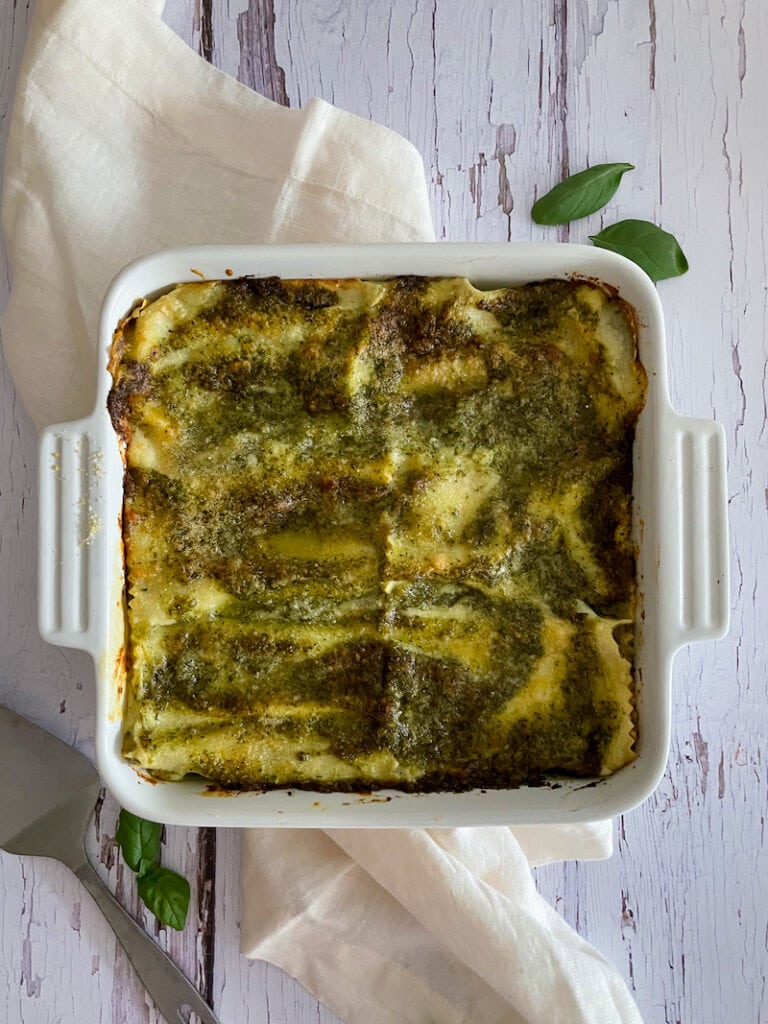
Pesto Lasagna Roll-ups: an easy pasta that will scream summer and freshness!
How to make homemade pasta dough: a useful guide, where you can find many answers for all that is egg pasta dough.
Please let me know in the comments how you like this Pappardelle recipe, and if you make it please leave a star rating! I would really appreciate it!
This post contains affiliate links for products we love. Italian Kitchen Confessions earns a small commission on these links at no cost to you.


Way too much moisture to flour ratio. Six eggs makes for a soupy goo that took me a long time to balance out, adding flour while hand kneading.I recommend not attempting this recipe as you will “Knead” another 30 minutes to get a dough that will not stick to your board/hands. I suspect mine is over kneaded at this point and will have a less than optimum texture once cooked, as a result. I have made pasta for many years after several cooking classes in Italy, I should have trusted my instincts instead of this recipe. I doubt anybody has made this recipe prior to publishing, let alone proofread for typos…. Quail eggs might work.
Sorry you did not like this recipe, and in addition I am Italian, born and raised so I have made pasta for many years. All recipes are tried and tested before being published. Pappardelle is an egg based pasta. In addition the flour is 406 gr ( there is a conversion calculator Metric in the recipe.) The eggs mentioned in the recipe are 4, as it is shown also in the picture. I am not sure why you have these ratios and the adjustment is also for flour, and all the ingredients, not just for eggs. I hope it helps.
Follow up: Note that I adjusted the recipe from 4 to 6 diners, thus the six eggs were called for in the auto adjustment.
And apologies if there were typo, English is not my first language, but I am trying my best.